A single scanned loan file enters as one undifferentiated blob. The engine classifies it, reads it, validates data across competing sources, applies the full agency rulebook, and writes precise, data-driven conditions back into the System of Record (SOR), Loan Origination System (LOS), or Servicing System (SS).
Book a DemoA closed loan may be ready to move into servicing, but the file itself can still arrive as a dense, undifferentiated package of scanned documents. Before boarding, the right documents must be identified, controlling versions established, critical data extracted and reconciled, program-specific rules applied, and discrepancies converted into conditions that operations teams can act on.
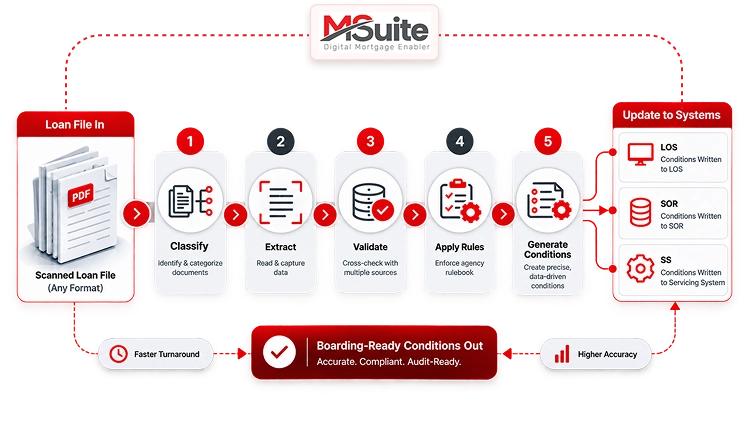
At portfolio scale, mortgage servicing teams face a challenge that goes beyond reading documents. It is executing the same review logic consistently across changing document sets, loan programs, source systems, and data conditions. MSuite's MSR Review Engine brings these steps into a structured, automated review workflow, from the incoming closed-loan package through to actionable SOR/LOS conditions.
Files are picked up the moment they land — nights, weekends, and holidays included. There is no business-hours queue and no overnight backlog waiting for staff to return.
Capacity expands from baseline to five times throughput in three days, so seasonal swings in mortgage volume never become a bottleneck — and it contracts back down just as fast.
Every loan moves through the same structured review path, from an undifferentiated scanned package to actionable conditions in the SOR/LOS.
The entire closed-loan package arrives as a single scanned PDF blob — no bookmarks, no order, no labels. Before any rule can be applied, the engine establishes what is contained in the file.
What previously required manual review and comparison across loan documents is executed through a single, deterministic review cycle.
Across a single automated review, the MSR Review Engine handles:
Together, these elements define the scope of a single automated boarding review. The engine does not apply one standard check to every loan; the review path adapts to the documents available, the data extracted and reconciled, and the rules applicable to the specific loan program.
After classification, the engine selects the source documents needed for rule evaluation, with required and conditionally required documents varying by the applicable agency or investor program.
Extracting a value is only the beginning of the data problem. Each field is extracted from a primary source and cross-checked against fallback sources to account for poor scan quality. Some fields use a waterfall of up to seven candidate sources before a value is trusted.
The source waterfall connects document extraction with rule execution, allowing the rule engine to work with a resolved value rather than simply accepting the first value encountered in the file.
Boarding logic adapts to the specifics of each loan. The applicable loan type, agency program, and documentation type determine which rules are applied and which conditions are generated.
The configuration spans 11 program variants and five agencies, allowing the review path to adapt according to the loan rather than forcing every file through an identical set of checks.
Rules do more than return a binary pass or fail. They route poor-quality scans back for review, derive missing values, reconcile source discrepancies, and only then raise a condition.
Identifying a discrepancy is only part of the review. The issue must also be converted into a structured condition that can be tracked and acted on within the servicing workflow.
Each condition is assigned an SOR/LOS category and tracking code, with condition verbiage generated dynamically from the identified data values before being posted to the SOR/LOS.
Rather than leaving the result as an isolated exception report, the engine converts the rule finding into a structured condition that can enter the downstream operating workflow.
See how MSuite's MSR Review Engine can classify loan packages, reconcile data across sources, execute program-aware checks, and generate structured conditions within your existing mortgage environment.
Talk to an MSuite Expert